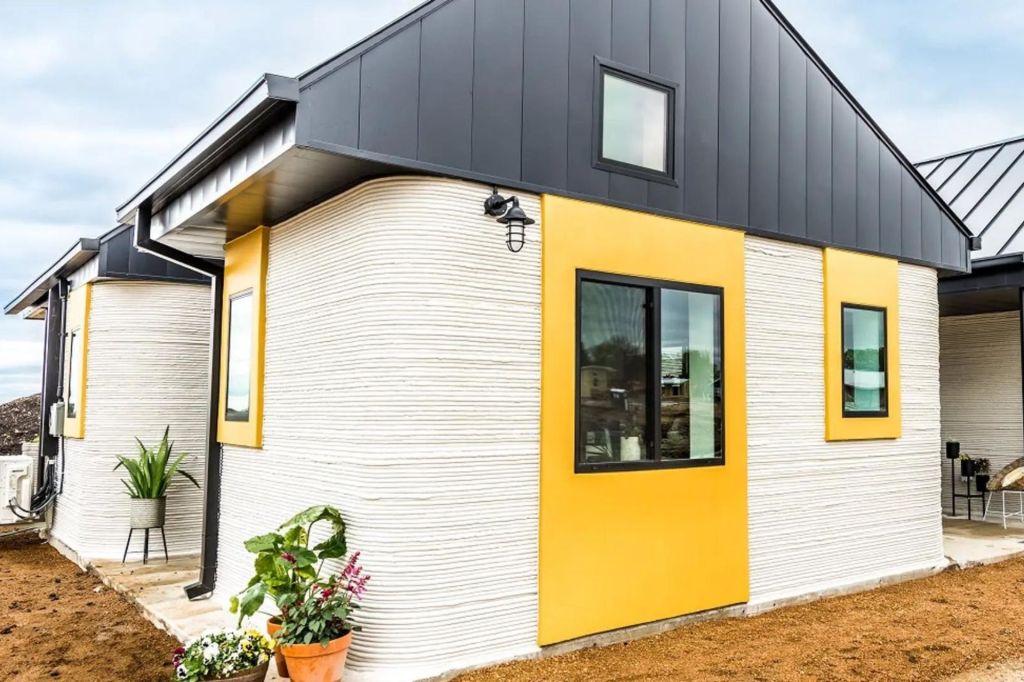
3D-printed housing can provide sustainable, affordable homes for millions. Using additive manufacturing, developers can build houses with less money, time and resources than conventional construction. 3D printing is powering innovation in sustainable development, from luxury houses to tiny homes for people without housing.
How Does 3D-Printed Construction Work?
When most people think of 3D printing, they imagine a tabletop printer making plastic models with strings of filament. Could we really use this technology to make buildings? Yes! Industry innovators are already applying 3D printing to construction with amazing results.
3D-printed housing is created using giant robotic printers that deposit concrete rather than plastic (although the concrete sometimes contains plastic). The printer autonomously extrudes concrete to build the house’s walls using the floor plan. Contractors come in to install the interiors, windows, doors and roofing once the walls are complete.
“Robotic construction is absolutely our future. This is a complete transformation in the way we approach sheltering ourselves,” ICON CEO Jason Ballard explained in a recent interview. Ballard’s 3D-printed housing company is one of the industry’s leading innovators today.
Benefits of 3D-Printed Housing
The idea of robots autonomously building houses sounds cool, but is it more effective than conventional construction? There are several benefits to 3D-printed housing.
Sustainability
Traditional construction methods have a severe negative impact on the environment. Building materials and construction generate 13% of global GHG emissions each year. In addition to emissions, construction damages the local environment surrounding building sites. That damage can include water pollution, habitat destruction, air pollution and food chain disruptions. The duration of conventional construction projects only worsens the issue – a typical house can take over nine months to build.
3D-printed housing has a significantly smaller carbon footprint. Building times are drastically shorter, even as low as a single week for an entire house. The condensed work time reduces emissions and disruption to local wildlife. 3D-printed homes also require less lumber, shifting instead to concrete.
It’s worth noting that conventional concrete production is emissions-intensive. Luckily, industry innovators are developing green concrete alternatives to address this issue. For example, Kenyan entrepreneur Nzambi Matee creates bricks made of recycled plastic stronger than concrete through her startup Gjenge Makers. The UN named Matee Africa’s 2020 Young Champion of the Earth for her incredible invention.
Additionally, the nature of additive manufacturing prevents most material waste. The 3D printer only uses the exact amount of material necessary to finish the print. Any concrete left over can be used on a future project. Plus, automation reduces the likelihood of rework, errors and accidents.
Cost and Efficiency
A fantastic practical benefit of 3D-printed housing is the potential for high-efficiency, low-cost construction. 3D printing requires significantly fewer construction workers and takes far less time to complete compared to wood-frame housing.
These factors can make 3D-printed houses more cost-effective, potentially resulting in lower prices for home buyers. With enough innovation and development, 3D printing could revolutionize the housing market and make homeownership a reality for millions.
At least 150 million people worldwide are homeless today. Affordable, accessible housing can save lives and rejuvenate people’s sense of dignity and independence. Housing developers and industry leaders are already eyeing 3D printing as a potential solution to homelessness.
In fact, the first 3D-printed tiny house in the U.S. was rented to a formerly-homeless man named Tim Shea, a resident at the Community First Village in Austin, Texas. Since Shea’s home was completed in 2021, the 3D-printed housing industry has come a long way.
For instance, ICON is developing the largest 3D printed neighborhood in the U.S. in Austin, Texas. Wolf Ranch, the Austin neighborhood, includes 100 homes starting in the $400,000 range, but it is also the first project of its kind. This large proof-of-concept neighborhood could pave the way for much more affordable 3D-printed neighborhoods in the future.
ICON also launched a project in 2023 called Initiative 99. It’s an open design contest for 3D-printed homes that could be built for less than $99,000. ICON’s founder specified that the board of judges for Initiative 99 will be looking for beautiful, welcoming homes, not just cheap utilitarian designs.
Rapid, low-cost 3D-printed construction could also help communities rebuild after natural disasters. With more development, construction-grade 3D printers could become more mobile so they can operate in remote areas and urban regions. This could allow communities in virtually any nation or location to build durable, sustainable housing.
Durability
3D-printed housing isn’t just better for the environment. It’s also better for people. 3D printing makes these homes far more durable than traditional wood frame houses. The layered concrete walls are more effective for insulation and more resilient against severe weather incidents and fires.
Innovations in 3D-Printed Housing
3D printing housing is becoming more common every year. It’s already hitting the prefab housing market. 3D printed home builder Mighty Buildings uses additive, mass manufacturing to create homes with 99% less waste, for 20% less money and in half the time of conventional construction.
A neighborhood of 10 3D-printed homes was recently completed in Tabasco, Mexico, with support from the non-profit New Story Homes. These homes went to families living on less than $80 per month. It won’t be the last time generous organizations use 3D printing to give people a safe, reliable place to live.
The first 2-story 3D printed home in the U.S. was built in January 2023, breaking a significant milestone for the industry. Previously, 3D printing was limited to the first floor only. A wider variety of homes can now be built with larger, scalable printers.
3D-printed housing is also seeing innovations in sustainable printing materials. In late 2022, the Advanced Structures and Composites Center at the University of Maine unveiled the first 3D-printed house made with 100% bio-based materials. This incredible breakthrough could help spearhead innovations in net-zero construction using 3D printing.
Sustainable Construction With 3D Printing
3D-printed housing is the future of green construction and the entire housing industry. It can provide safe, durable, comfortable homes for millions of people worldwide. The best part? Those homes can be built with low emissions, low waste and low cost.
 STEVIE BONIFIELD
Leave a Reply